The first opening slot on a weekday, or the last hour before closing, is easiest. The courtyard is small, and tour groups stack up quickly from late morning. If you want a clean balcony view and shorter photo lines, avoid 11am–3pm.
Verona's Juliet house
4.4(848)
Juliet’s Courtyard tickets
Included with Verona's Juliet house tickets
Timings
RECOMMENDED DURATION
1 hour

Quick overview
- Access: Included in all Juliet’s House tickets
- Separate ticket: Not required
- When you’ll see it: First stop, before the house museum and balcony
- Visit duration: 10–15 min self-guided / 15–20 min with guide
- Best time: First opening slot on a weekday, or the last hour before closing, because the courtyard fills quickly from late morning
- Restrictions: Photography is generally allowed; follow staff directions around the statue and use the official letterbox for notes
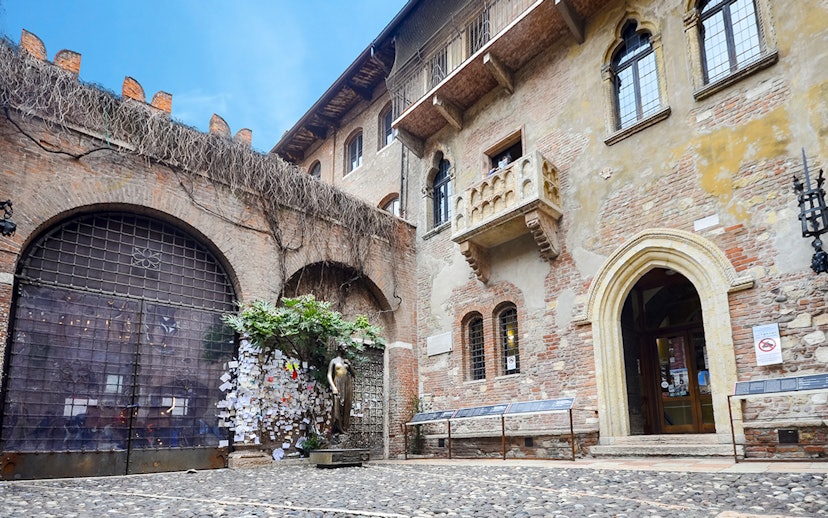
Juliet’s Courtyard is included with all Juliet’s House tickets. No separate ticket is needed. It is the first space you reach before the house museum and balcony, framing the bronze statue, balcony view, and note-covered archway that define the site’s literary identity. Arrive early and pause here with intention, because this small entrance court shapes the entire Juliet’s House experience and bottlenecks quickly once crowds build.
How to best experience Juliet’s Courtyard
Best time to visit
How long to spend
Allow 10–15 minutes if you are visiting only the courtyard. With a guide, 15–20 minutes gives you time to understand the balcony, statue, and Capello link. If you rush through the archway, the stop becomes just another crowd photo.
Where it fits in your itinerary
You reach the courtyard at the very start of the Juliet’s House experience, just off Via Cappello. Most visitors slot it between Piazza delle Erbe and Piazza Bra. Treat it as a short central Verona stop, not the only major highlight of your morning.
Crowd patterns
Crowds peak from late morning through mid-afternoon, especially on weekends, holidays, and summer days. At those hours, the statue line slows, the balcony view clogs, and the space feels tighter than it is. Earlier visits feel calmer and far easier to photograph.
What to prioritize if time is short
Stand just inside the courtyard entrance first for the clearest full-balcony view. Then look for the bronze Juliet statue and the Capello crest above the archway. If you only have 5 minutes, skip the longest photo queue and read the space before chasing a pose.
Common mistakes to avoid
Most visitors join the statue line immediately and never study the courtyard itself. Look up at the balcony, back toward the arch, and around the walls before taking photos. Also, do not assume notes, touching rituals, or long photo pauses are consequence-free.
Best Tickets to Experience Juliet’s Courtyard
| Ticket type | Why choose it |
|---|---|
Courtyard only | Best for a quick balcony view, statue photo, and central Verona stop without committing museum time. |
House ticket | Adds the balcony and small museum, so the courtyard becomes the opening scene rather than the whole visit. |
Guided walking tour | Gives you Verona context and helps you time the courtyard around peak groups and photo bottlenecks. |
Why it’s worth seeing
Juliet’s Courtyard is irreplaceable because it turns Verona’s most famous fictional scene into a physical approach: the balcony only works because this small court stages the view from below. Most visitors do not realize the balcony they photograph was added in the 1930s, long after Shakespeare. Slow down for three details here — the balcony sightline, the bronze statue, and the entrance arch — and the stop feels more layered than its crowds suggest.
The balcony view from below
Stand a few steps inside the archway and look straight ahead to frame the balcony without too much upward distortion. This is the perspective that matters most, because the courtyard creates the famous Romeo-looking-up view visitors usually imagine first.
The bronze Juliet statue
The statue stands at courtyard level and pulls most of the queues. Step slightly to either side, not directly in front, to see both the figure and the brick backdrop. Its worn surface tells you how heavily visitors have turned ritual into habit here.
The archway and Capello link
Before entering fully, look above the arch for the Capello family connection that helped later visitors associate this house with the Capulets. The tunnel walls, love notes, and letter tradition also explain why the courtyard feels part monument, part public confession board.
The courtyard belongs to a 14th-century house linked to the Capello family, whose name helped later visitors connect it with Shakespeare’s Capulets. The balcony most people photograph was added in the 1930s, turning a modest service court into a literary stage. Today the courtyard functions as a modern ritual space for photos, letters, and romantic pilgrimage, even as the house museum provides the historical frame behind it.
👉 Explore the full history of Juliet’s House
Notable figures
William Shakespeare | Playwright
His play made this small Veronese courtyard globally recognizable.
View Wikipedia
Antonio Avena | Restorer
Reworked Juliet’s House in the 1930s and shaped the balcony visitors know today.
View Wikipedia
Franco Zeffirelli | Film director
His 1968 Romeo and Juliet props helped fix the site in modern popular memory.
View Wikipedia
Know before you go
- Open: Typically Tuesday to Sunday, 9am–7pm
- Monday: Typically 1:30pm–7:30pm
- Last entry: 30 minutes before closing
- Booking: Timed online reservations are commonly used during busy periods
- Official site: Check current hours before visiting: Verona Musei – Casa di Giulietta
- Address: Via Cappello 23, 37121 Verona, Italy
- Google Maps: Search ‘Juliet’s House, Via Cappello 23’
- From Verona Arena: Around a 10-minute walk via Via Mazzini
- From Verona Porta Nuova station: About 25 minutes on foot, or bus toward Piazza Bra/Ponte Navi plus a short walk
- Entry point: Enter through the archway on Via Cappello; the courtyard comes before the museum rooms and balcony
- Courtyard access: Ground-level entry, but the paving is old stone and cobblestones
- Wheelchair access: The courtyard is reachable; the balcony and upper museum rooms are not step-free
- Elevator: None for the upper floors
- On-site support: Bilingual signage is commonly available, and audio-guide/app options can add context
- Seating: Limited resting space inside the courtyard during peak periods
- Required: No special dress code applies to the courtyard
- Not permitted: Standard public decency rules apply
- Coverings available: Not applicable
- Enforcement: This is not a religious site
- Photography: Generally allowed; avoid flash where interior signage requests it
- Statue: Follow staff directions around queues; repeated touching has previously damaged the statue
- Letters: Use the official red letterbox for longer messages; wall notes are periodically removed
- Bags: Large bags may be restricted before entering the house museum
- Capacity: Staff may pause entry flow during especially crowded periods
- Stairs: None are required to enter the courtyard itself
- Standing: Expect 10–20 minutes on your feet in a compact, crowded space
- Difficulty: Easy for the courtyard; moderate only if you add the balcony and museum stairs
- Surface: Old paving can feel uneven, especially after rain
- Alternative: Stay in the courtyard if you want to avoid interior stairs
FAQs
Yes. The courtyard is part of every Juliet’s House visit, and no separate courtyard ticket exists.
No. Any Juliet’s House ticket covers it. If you only want the entrance courtyard, local access rules can vary during crowd-control periods.
Yes. The courtyard sits at the entrance on Via Cappello. The paid house museum and balcony come after it.
You reach it first, immediately after the archway off Via Cappello. Most visitors spend 10–15 minutes there before deciding whether to continue inside.
Allow 10–15 minutes on your own, or 15–20 minutes with a guide. The small space rewards a slow look upward, not a rushed photo stop.
Yes. Many Verona walking tours stop here. A guide helps you read the balcony, the Capello link, and the house’s theatrical reinvention.
Often, yes. The courtyard has historically been accessible without museum admission, though temporary access controls can change during especially busy periods.
Photos are generally allowed. Touching the statue has long been a visitor ritual, but follow current on-site staff instructions and expect queues.
Partly. The courtyard is ground-level, but cobblestones can be uneven. The balcony and upper museum rooms are not step-free.
More reads
Juliet’s House Verona tickets, balcony, and museum guide
[Link to main attraction page]
Romeo and Juliet sites to explore across Verona
[Link to related shoulder page]
How to visit Verona Arena and Piazza Bra
[Link to related shoulder page]