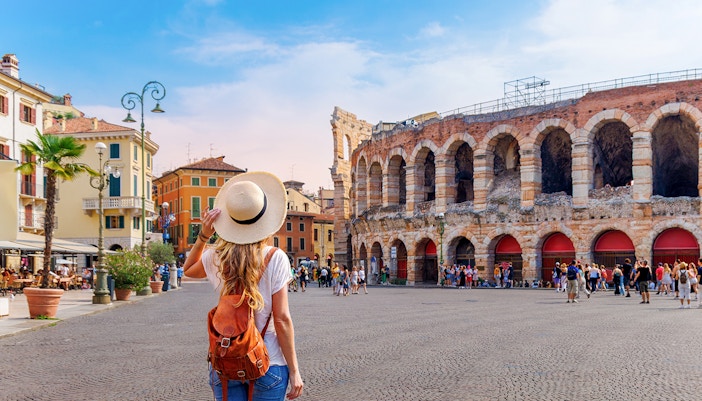
13th–14th centuries — Juliet’s House began as a real medieval townhouse in a busy Veronese neighborhood. Its strongest historical anchor is the documented Cappello family connection, which gave later generations a plausible link to Shakespeare’s Capulets.
History of Juliet’s House
Few places feel as storied as this compact Veronese courtyard, where the world’s most famous balcony scene plays out on a balcony added only in the 1930s. That tension between medieval fact and literary legend makes every room more interesting.
Juliet’s House timeline
- 13th century: Medieval origins — The core house rises in Verona’s old center.
- 14th century: Cappello ownership — Records link the property to the Cappello family, echoing the later Capulet name.
- 1530: Italian literary roots — Luigi da Porto’s novella places tragic lovers in Verona.
- 1597: Shakespeare spreads the myth — Romeo and Juliet turns Verona’s lovers into a global story.
- 1800s: Romantic tourism begins — Travelers start seeking real-world Juliet and Capulet sites.
- 1905: City acquisition — Verona acquires the house and begins preserving it.
- 1930s: Restoration and balcony — Antonio Avena reshapes interiors and adds the now-famous balcony.
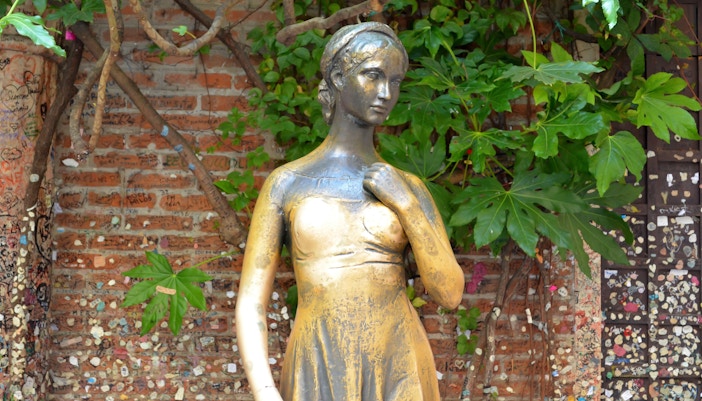
- 1972–2014: Juliet statue era — The bronze statue is installed, then replaced outdoors after heavy wear.
- 2025: Crowd controls added — Timed online reservations are introduced during peak demand.
Juliet’s House history explained
Medieval house and family name
From Italian tale to Shakespeare
1530–1597 — Verona’s star-crossed lovers entered literature before Shakespeare, through Italian retellings. Shakespeare made the story universal, but his play did not identify this specific building as Juliet’s home.
Romantic rediscovery
1800s — As literary tourism grew, visitors wanted a physical Juliet landmark. Local tradition, surname similarity, and Verona’s own storytelling gradually turned this house from medieval residence into romantic destination.
Civic reinvention
1905–1930s — After the city acquired the building, restoration gave it the image visitors now recognize. Conservation mixed with stage-setting, especially in the interiors and balcony, shaping today’s experience as much as medieval history did.
Global ritual site
1970s–today — The statue, letters, film memorabilia, and museum route transformed the house into a living ritual of love. What you visit now is both a preserved building and a carefully curated cultural symbol.
Construction and architecture of Juliet’s House
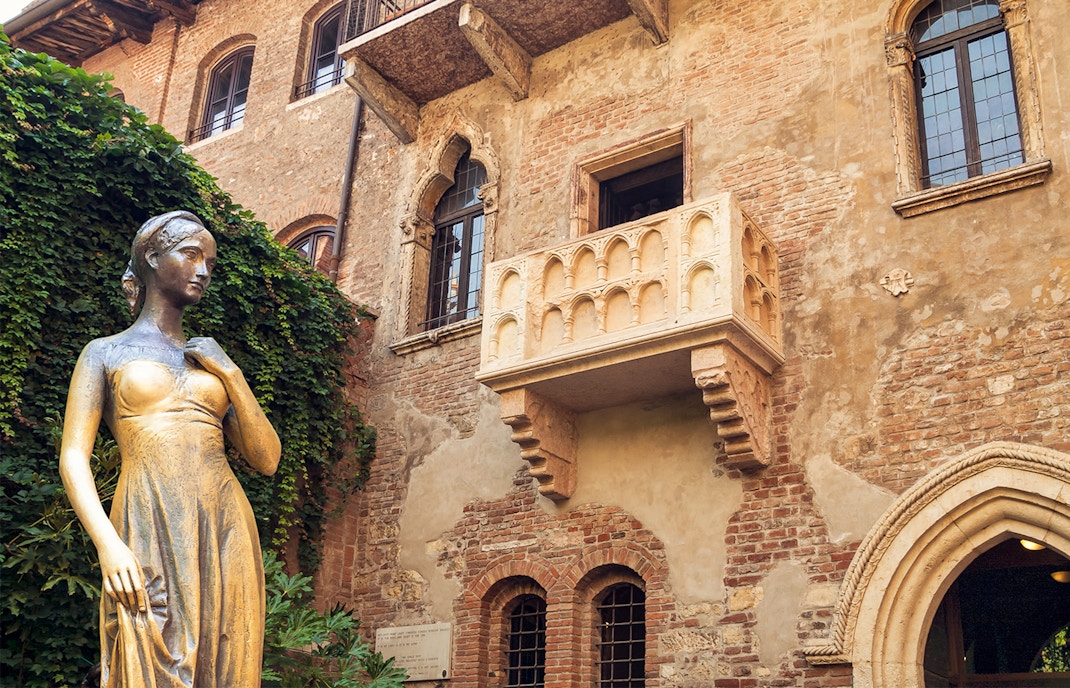
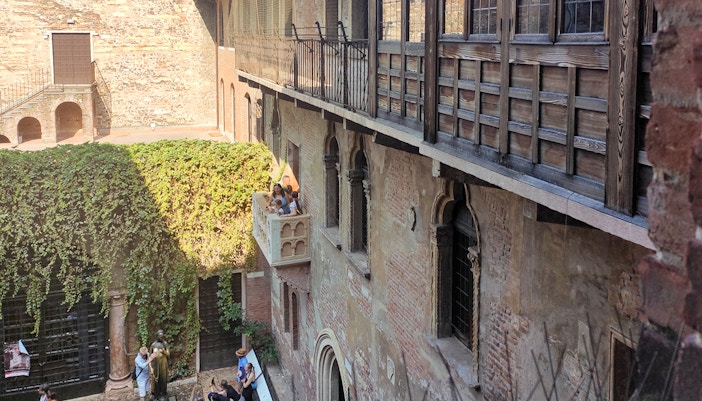
Built in brick and stone around a small courtyard, the house preserves layers of medieval Verona rather than a single untouched moment in time. You’ll notice Gothic-style windows, an arched entrance, and the Cappello family crest above the passageway. Much of the romantic image visitors expect today — especially the balcony and some staged interiors — comes from Antonio Avena’s 1930s restoration. Reading those layers is what makes the architecture rewarding on-site.
Fact vs myth: what historians agree on
Historians agree that the building has medieval origins, but there is no confirmed evidence that a historical Juliet lived at this address. Here’s the clearest way to separate documented history from later tradition.
Documented history: The house is a real medieval building in Verona. Historical records link the property to the Cappello family, and Verona later developed the site as part of its literary tourism around Romeo and Juliet. The famous balcony was added during a 20th-century restoration, while visitor rituals such as letters, luck gestures, and statue-touching are modern traditions.
Legend and tradition: Juliet herself is not proven to have lived here. The Cappello family is often associated with Shakespeare’s Capulets, but that link is part of later storytelling rather than settled fact. The balcony is not original to Juliet’s time, and the house was not continuously recognized for centuries as Juliet’s home.
A useful rule for your visit: trust the masonry, documents, and family crest as history; treat the balcony, rituals, and theatrical mood as part of Verona’s later cultural storytelling.
Juliet’s House today – Why it matters
Juliet’s House today – Why it matters
Today, Juliet’s House is a municipal museum on Via Cappello 23 and one of Verona’s best-known cultural landmarks. Visitors can enter the courtyard, see the balcony, move through restored rooms, and spot film props, period-style furnishings, and the original bronze Juliet statue indoors. In peak periods, timed reservations may be used to reduce crowding and protect the building’s fragile fabric. For practical details, continue to the Juliet’s House About page or main visitor guide.
Frequently asked questions about Juliet’s House’s history
The core structure dates to the 13th century, with important surviving features from the 14th century, when the Cappello family was associated with the property.
No archival record proves that a historical Juliet lived in this house. The site is better understood as a literary and civic association than a verified biography.
The connection comes from Verona’s earlier love-story traditions and the similarity between Cappello and Capulet. Shakespeare helped globalize the legend, but he did not identify this address.
No. The famous balcony was added in the 1930s during restoration to match visitor expectations of the story.
The best-known historical link is to the Cappello family, a real Veronese family documented in the medieval city.
Interest grew in the 19th century, and the city formally shaped the site into a public attraction after acquiring it in 1905.
Mainly the documented Cappello ownership and the family crest above the entrance arch. That supports an association, not proof of Shakespeare’s fictional household.
Romeo’s House is another tradition-linked medieval building in Verona, but it is not staged as a museum in the same way. Juliet’s House became the city’s main literary symbol.
It’s a modern tradition, not a medieval one. Over time, visitors turned Juliet into a symbolic listener for love advice and confessions.
Look closely at the original stonework, archway, and crest, and follow current preservation rules. If you want to join the tradition, use the official letter box rather than attaching items where signage asks you not to.
More reads
Want to keep the story going? These practical guides help you connect the legend to the real city, discover nearby sights, and plan the rest of your Verona visit.
Juliet’s House tickets
Juliet’s House highlights

Getting to Juliet’s House