Aim for the first weekday entry or the last hour before closing. The courtyard is small, so even moderate crowds change the experience from a quick romantic stop into a shoulder-to-shoulder queue. Avoid late morning and weekend afternoons.
Quick overview
- Access: Included in all Juliet’s House tickets
- Separate ticket: Not required
- When you’ll see it: Start of the visit, in the courtyard before the museum rooms and balcony
- Visit duration: 10–15 min self-guided / 20–30 min with a guided city walk
- Best time: First entry slot on a weekday, or the last hour before closing, when the courtyard photo line is shortest
- Restrictions: Photography is allowed. Tripods may require permission inside Juliet’s House
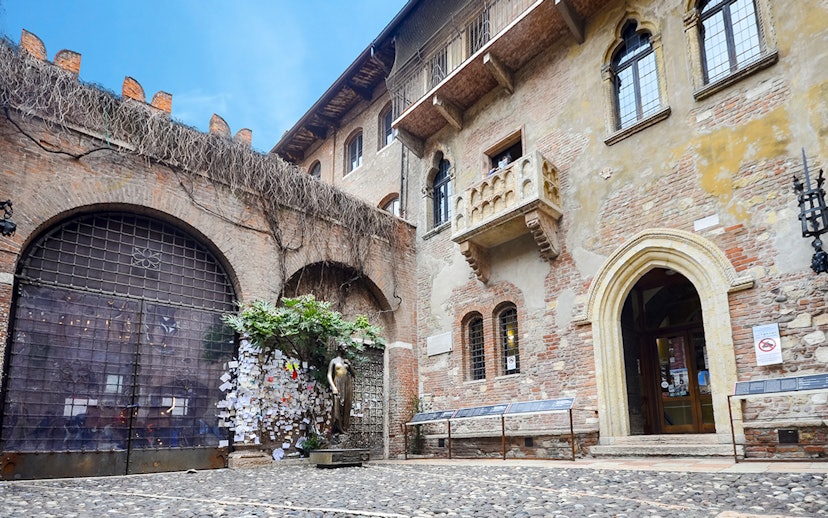
Juliet’s Statue is included with all Juliet’s House tickets, and no separate ticket is needed; its importance comes from the ritual that turned a literary heroine into Verona’s most photographed symbol of luck in love. You’ll see it at the very start of the visit, in the courtyard off Via Cappello, before any interior rooms or balcony access. Arrive early and treat this stop as more than a photo line, because the atmosphere changes quickly once the courtyard fills.
How to best experience Juliet Statue
Best time to visit
How long to spend
Plan 10–15 minutes if you only want courtyard photos and the statue ritual. Allow 30–45 minutes if you’re also entering the house and balcony. If you rush, the visit feels like a checkbox rather than a memorable Verona stop.
Where it fits in your itinerary
Because the statue sits right in the entrance courtyard, it works well early in an old-town walk or between Piazza delle Erbe and the Arena. Don’t leave it for peak midday if photos matter to you more than simply saying you came.
Crowd patterns
Crowds build quickly from late morning, especially in spring, summer, and around romantic travel dates. At the busiest times, the main wait is usually for photos beside the statue. Go early if you want more than a few seconds of clear space.
What to prioritize if time is short
If you only have 10 minutes, frame the statue with the balcony above, read a few love notes in the archway, and decide whether the interiors matter to you. Skip the longest pose queue if you’re trying to keep your day moving.
Common mistakes to avoid
Most visitors join the statue line before checking the best courtyard angle for a full statue-and-balcony photo. Another common mistake is assuming balcony access comes with courtyard entry. Decide in advance whether you’re doing exterior only or the full house visit.
Best tickets to experience Juliet Statue
| Ticket type | Why choose it |
|---|---|
Standard house ticket | Best if you want the statue, interior rooms, and balcony in one short visit. |
Verona Card | Best if the statue is only one stop in a fuller Verona sightseeing day. |
Guided walking tour | Best if you want the statue placed in Verona’s wider Romeo-and-Juliet story. |
Why it’s worth seeing
The Juliet statue in Verona is irreplaceable because this is where a literary legend becomes a real visitor ritual: people don’t just look at it, they perform around it. Many visitors don’t realize the original bronze statue, installed in 1972, was moved indoors after years of touching damaged the metal, and the courtyard figure today is a 2014 replacement copy. Focus on these three details before you move on.
The statue: notice the polished right side
The smooth, brighter area on Juliet’s right breast shows how many visitors still follow the luck-in-love ritual. It’s the clearest visual proof that this courtyard works less like a museum display and more like a living visitor tradition.
The courtyard angle: frame the statue with the balcony
Stand slightly left of center in the courtyard and look back toward the façade. From here, you can photograph the statue in the foreground and the balcony above it, which captures the site’s two symbols in one clear shot.
The archway and red mailbox
Before or after the courtyard, pause under the entry archway to read the layered love notes and spot the red letterbox. It explains why the statue doesn’t stand alone here; it belongs to a larger culture of letters, wishes, and public romance.
For decades, the statue has carried a ritual that feels older than it is: touching Juliet for luck in love. The original bronze, installed in 1972, became so worn that it was moved indoors, and the courtyard figure today is a 2014 replacement. What began as a literary homage became one of Verona’s most durable visitor traditions, tying Shakespeare’s imagined heroine to real declarations of love.
Explore the full history of Juliet’s House.
Notable figures
William Shakespeare | Playwright
His tragedy gave Verona’s lovers global fame and made this courtyard legible to modern visitors.
Link: https://en.wikipedia.org/wiki/William_Shakespeare
Antonio Avena | Restorer
He led the 20th-century restoration that shaped the house and added the balcony visitors know today.
Link: https://en.wikipedia.org/wiki/Antonio_Avena
Franco Zeffirelli | Film director
His 1968 Romeo and Juliet props inside the house deepened the site’s cinematic afterlife.
Link: https://en.wikipedia.org/wiki/Franco_Zeffirelli
Know before you go
- Hours: Opening hours vary seasonally, so check the official Casa di Giulietta page before you go
- Monday: The museum opens in the afternoon; Monday morning is closed
- Last entry: Final entry is 30 minutes before closing
- Entry system: Timed online entry may be required during busy periods
- Official info: casadigiulietta.comune.verona.it
- Address: Via Cappello 23, 37121 Verona, Italy
- Google Maps: Search for ‘Casa di Giulietta’
- Nearest landmark: Piazza delle Erbe is about 2 minutes away on foot; the Arena is about 10 minutes away
- From Verona Porta Nuova: Around 15 minutes by bus and walk, 8 minutes by taxi, or 25 minutes on foot
- Entry point: Enter through the archway off Via Cappello; the statue is in the courtyard immediately inside
- Courtyard access: The courtyard is at street level, but the surface is cobbled and uneven in places
- Wheelchair access: You can reach the courtyard and see the statue from below
- Interior access: The balcony and upper museum rooms require stairs
- Elevator: No elevator is available to the upper floors
- On-site support: Informational panels are available in multiple languages, and audio-guided options may be available depending on your ticket type
- Required: Not applicable
- Photography: Allowed in most areas; flash-free photography is the safer choice around historic interiors
- Tripods: Professional photo gear may require permission
- Large bags: Staff may ask you to use bag check before entering interior rooms
- Timed entry: Arrive for your reserved slot during busy periods
- Capacity control: Staff may pause entry briefly when interior rooms are full
- Stairs: Required if you want to reach the balcony and upper rooms
- Standing: Expect to remain on your feet for 20–45 minutes
- Surface: The courtyard has old cobblestones and can feel uneven
- Difficulty: Easy for courtyard-only visits, moderate for the full house and balcony route
- Alternative: If stairs are an issue, you can still enjoy the statue and balcony view from the courtyard
FAQs
Yes. Entry to the Juliet Statue is included with every Juliet’s House ticket. No separate ticket exists for the statue itself.
No. You only need a Juliet’s House ticket if you also want the museum rooms and balcony. Courtyard access rules can change during crowd-control periods.
Yes, usually. You enter through the Via Cappello archway into the courtyard, but balcony access still requires the house route and ticket.
You’ll see it almost immediately. The statue stands in the courtyard before the interior rooms and balcony, usually within a few minutes of arrival.
Plan 10–15 minutes for the statue and courtyard, or 30–45 minutes if you’re also touring the house and balcony.
Yes. Guided Verona walks and Romeo-and-Juliet-themed tours often include the courtyard, and sometimes the house, with context you won’t get from a quick photo stop.
No. There’s no dress code for the statue or courtyard, so normal city sightseeing clothing is fine.
Yes, gently. The luck ritual centers on touching Juliet’s right breast, but repeated rough handling damaged the earlier statue.
Partly. The courtyard is accessible, but the balcony and upper museum rooms require stairs.
Yes. The courtyard is central and quick, so you can see the statue without turning it into a full museum stop.
More reads
Juliet’s House Verona tickets, timings, and visitor guide
Link: Juliet’s House main attraction page
Verona Arena tickets and what to see nearby
Link: Verona Arena main attraction page
Romeo and Juliet sites to explore across Verona
Link: Related Verona shoulder page